Digital Record Keeping for Animal Breeders
Published by Loopy on January 8th, 2026

Most breeding programs don’t start messy.
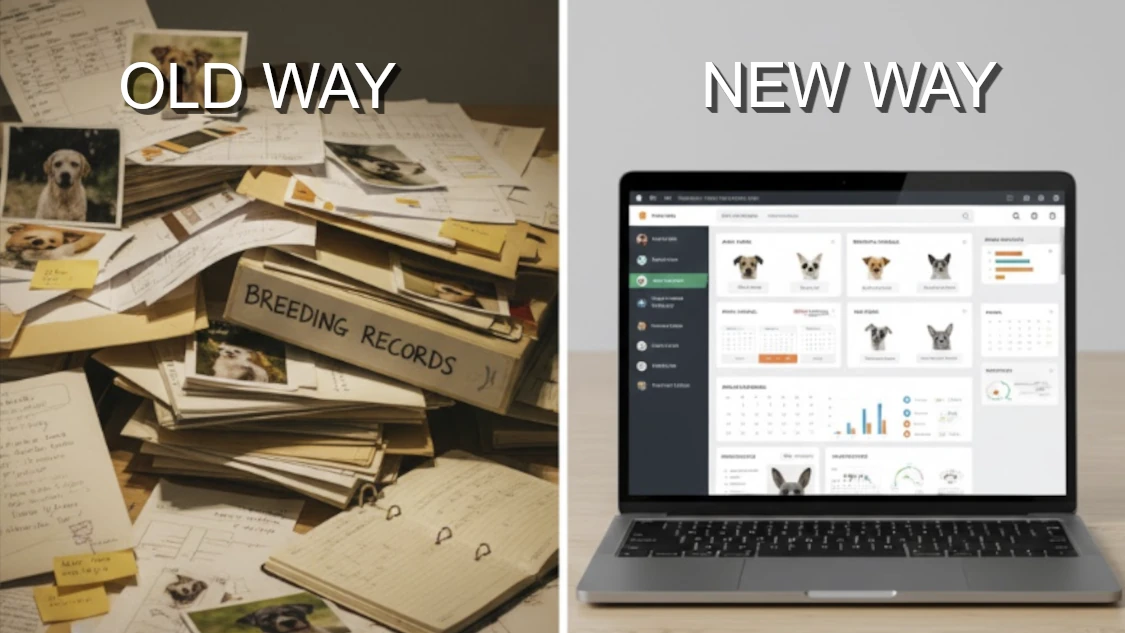
In the beginning, record keeping usually feels simple enough. A notebook for heats. A folder for pedigrees. A few vet receipts tucked into an envelope. Maybe a spreadsheet once things get a little more serious. At that stage, everything still fits comfortably inside your head.
The trouble begins quietly.
A second breeding animal enters the program. Then a third. Litters start overlapping. Health records multiply. A buyer asks a question you know you’ve documented somewhere—just not where. What once felt manageable now requires mental gymnastics just to stay confident that nothing has been missed.
Digital record keeping tends to enter the conversation right around this point—not because breeders suddenly want new software, but because older systems stop scaling with the realities of an active breeding program.
This article explores how record-keeping challenges evolve as breeding programs grow—and what it looks like to move from scattered information to systems that actually support daily decisions.
When memory stops being enough
Experienced breeders often rely on memory longer than they should. You remember which female had a difficult whelping. You remember which male throws stronger hips. You remember who’s due for a booster “sometime this spring.”
But memory doesn’t age well under sustained pressure.
As programs grow, the risk isn’t that breeders stop caring—it’s that important details become fragmented across notebooks, devices, calendars, and conversations. Missed dates, duplicated records, and incomplete health histories aren’t signs of negligence; they’re symptoms of record-keeping systems that were never designed to handle growing complexity.
Digital records aren’t about replacing breeder knowledge. They’re about supporting it—so decisions are based on complete information, not best guesses made at the end of a long day.
The slow accumulation of paperwork
Another shift happens as breeding moves from passion into responsibility.
Many breeders respond by adding more paper or more spreadsheets. Separate files for litters. Separate folders for clients. Separate documents for finances. Each addition solves a small problem while quietly increasing the overall load.
This is often where frustration peaks—not because any single task is difficult, but because the record-keeping system as a whole demands constant attention just to keep it from breaking.
This is often the moment when breeders stop asking, “How do I keep this organized?” and start asking a different question: “What kind of system can actually hold all of this together without constant maintenance?
Seeing patterns instead of pages
One of the first things breeders notice after moving records into a digital system is how much context was missing before.
When data lives in isolation, patterns are hard to see. Health issues appear unrelated. Breeding outcomes feel anecdotal. Progress across generations becomes difficult to assess without hours of manual comparison. Without connected records, insights stay buried inside individual pages instead of informing future decisions.
Digitally connected records make it easier to step back and observe patterns over time—how lines develop, how health outcomes cluster, and how scheduling decisions ripple forward. These insights don’t replace veterinary guidance or breeder judgment, but they do create a clearer foundation for responsible decision-making.
Digital doesn’t mean complicated
A common hesitation is the fear that going digital will make things more complex.
In reality, good digital record keeping mirrors how breeders already think—just without forcing everything to live in separate places. Animals, litters, health events, breeding plans, and clients are naturally connected. Digital systems work best when they respect those relationships instead of forcing them into rigid forms. At their best, digital record-keeping systems act as a single source of truth—linking animals, litters, health events, and plans without requiring breeders to rethink their workflow.
This applies across species. While dogs are often the default example, the same structural challenges show up in cat breeding, reptile programs, horses, llamas, and other multi-animal operations. Different details, same underlying problem: too much important information spread too thin.
Reducing mental load, not adding tasks
Breeders carry an enormous amount of responsibility—often quietly and without much margin for error.
When records are fragmented, that responsibility turns into constant low-level stress: double-checking dates, re-reading notes, wondering if something was forgotten. A well-organized digital system doesn’t eliminate work, but it contains it. Information has a home. Tasks can be reviewed instead of remembered.
Confidence comes not from perfect recall, but from knowing the system will surface what matters when it’s needed.
This is the point where many breeders stop thinking about “software” and start thinking about sustainability—how to run a program that remains ethical, organized, and manageable over the long term.
Where BreederLoop fits into the picture
Some breeders choose to build their own digital systems from spreadsheets and shared folders. Others look for tools designed specifically around breeding workflows. Platforms like BreederLoop are built to centralize records, schedules, health data, and operational details in one place, with the goal of reducing administrative strain rather than adding to it.
If you’re exploring what a structured digital approach could look like in practice, reviewing how dedicated tools are organized can be informative—even if you ultimately decide to build your own system. For breeders who want to see what a structured, breeding-specific digital system looks like in practice, BreederLoop offers one example of how records, schedules, and health data can be unified in a single place. An overview of that structure is available here.

What comes next
Digital record keeping isn’t a single decision—it’s a gradual shift. Most breeders adopt it piece by piece, starting with the areas causing the most friction. In the articles that build on this guide, we’ll focus on the high-friction areas where better structure tends to deliver the biggest relief first.
In the sections that follow within this guide, we’ll explore how breeders move away from paper and spreadsheets without losing historical data, what “organized” actually looks like in day-to-day breeding operations, and how digital records support better health, planning, and compliance decisions.
Each of these topics deserves its own focused discussion. This article serves as the foundation—the big picture of why digital record keeping becomes essential as breeding programs evolve.
Because staying organized isn’t about perfection. It’s about building systems that grow with you, rather than against you.